
You ask an AI to write a children’s book. That’s possible. It comes out, it looks like a book, it reads like a book. And then the work begins. This is the story of two routes to the same goal: creating a children’s book with AI. The first ran via a Google app. The second ran completely locally — on its own hardware, without an account, without anything going out. Both delivered a book. One of them is all ours.
First: what AI can already do, immediately and for free
I had a children’s book made, suitable for 8–11 year olds, based on the Abundomy philosophy and the storyline of the adult book Abundomy 2.0 (see abundancey.com). The tool that did it is a Google app that makes it “free”, and there is also a tool that generates the prompts for a Storybook. The result turned out quite good — three parts, with Bram and Emma in the leading roles:
- Bram and Emma and the stolen tree — read part 1 →
- Bram and Emma and the Hidden Player — read part 2 →
- Bram and Emma and the New Game — read part 3 →
And at the same time it has its limitations. You have to be logged in with a Google account to see it and there are a lot of things you can’t do. I wanted to include a “for more Https://abundomy.com” and they softly refuse to do that — I’ve tried several tricks. That’s the first thing you learn: an AI that makes a book for you on a big-tech platform is not your book. It is a book that exists under someone else’s terms, on someone else’s platform, with rules that may be different tomorrow.
The inspiration
My inspiration was gained by The Tuttle Twins — Conner Boyack (author) and Elijah Stanfield (illustrator and co-creator). They met in 2012 at FreedomFest during the Ron Paul campaign and wrote the first book in 2014, because Boyack didn’t see anything suitable to teach his children about free markets, rights and freedom. An inspiring story — if you think of it as Conner Mike Rowe When you hear it told, you understand why it works. See tuttletwins.com. And then I met an inspiring lady, Yvonne against on substack who explains in an inspiring way how to use AI tools to optimize your workflow and save time. If you want to make a flipbook yourself, take a look to her explanation.
The second route: all by yourself, all local
Three books via a Google app is fun and it works. But the answer to “can AI do this?” was already yes. The more interesting question is: Can I do it myself, on my own hardware, without my story or my readers being in the hands of an American giant? That turned out to be possible — and that is the route we continued.
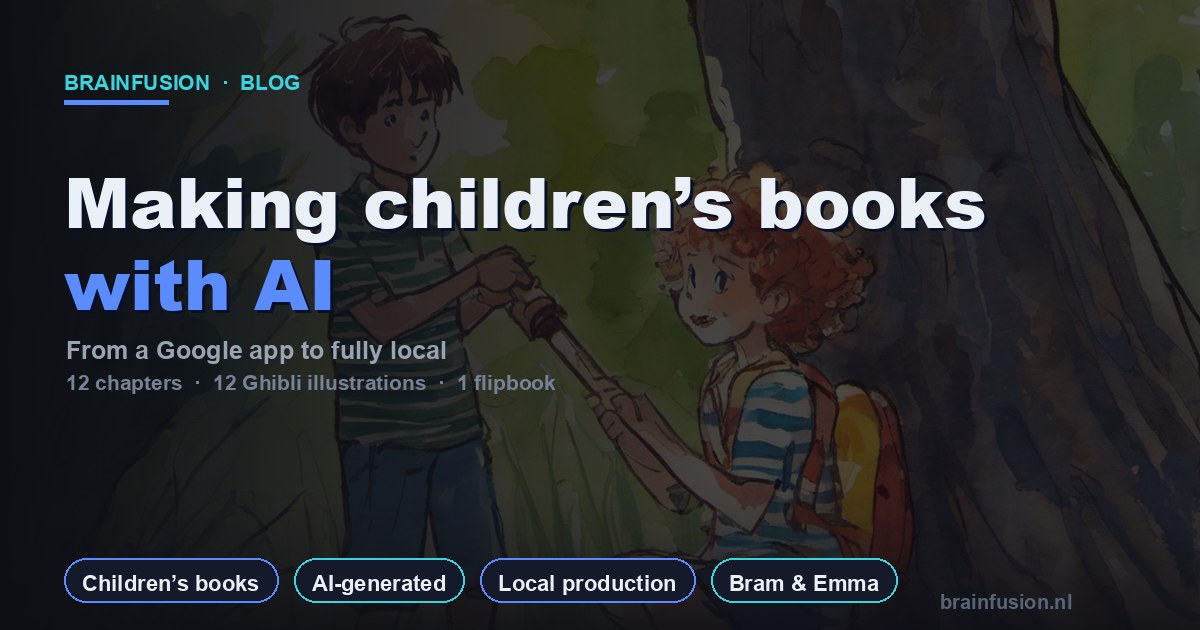
We built our own production flow, here at Brainfusion, that creates a complete children’s book from one source PDF: twelve chapters of 5–8 KB, told in a child’s voice, with twelve Studio Ghibli-style illustrations, and a final volume as a PDF and as a flip book. Everything runs locally:
- Text generated with
qwen3:32bvia Ollama, running on its own hardware. - Illustrations with SDXL (Base 1.0) via ComfyUI, also locally.
- No cloud, no account, no external API. The story never leaves your own machine.
The source is the same Abundomy 2.0, the main characters are the same Bram and Emma. Twelve chapters, twelve pictures, one book. And the most important difference with the Google route: this book is ours. The files are here, the flow is ours, no one can change the rules tomorrow.
What you learn along the way
An AI that makes a book “for free” is never free. You pay with control over your own story — where it is, who can refuse it, who can change it. That doesn’t have to be a problem, as long as you know it. The local route takes more effort (hardware, building flow, generating and checking chapters one by one) and delivers exactly the same as what you put into it: a book that is yours, under conditions you determine.
The flow itself is also a lesson. Each step verifies the previous one: is the chapter the right length, is the transition correct with the previous one, does the illustration match the text? AI that races uncontrollably delivers something that looks convincing but is wrong. AI that you directs and controls, delivers something that is right. That is not a difference in the model. That is a difference in people.
See for yourself
The first PoC result of the local route is below. It has not yet been adjusted expressly and is the result of my conditions and the local agents who implement it. — the complete flip book, twelve chapters, browseable in your browser. The arrow keys work on your phone too.
And if you want to see what the Google route yielded: the three parts above, still at Google. Read them and compare. Two routes to the same goal — and the question of which of the two you prefer.
Finally
Creating children’s books with AI is not a magic wand and not a threat. It’s a tool. You can let it tell a story and get a nice book out of it, from someone else, on their terms. Or you can take the tools, locally, and achieve the same goal with control in your own hands. Both are possible. The choice is not up to the AI. The choice is yours.
A book that is on a platform is a book that the platform can refuse.
A book that is with you is a book that no one can take away from you.
—Patrick